Lithuanian Airports (LTOU) have announced that a new advanced drone detection system has been installed at Palanga Airport. The new equipment was installed as the airport welcomes record passenger flows and an increasing number of flights. Palanga Airport invites residents and visitors of the city to obey rules and cooperate, but warns that violators will face fines. A similar system will soon start operating at Kaunas and Vilnius airports.
The established drone control zone of the airport, where drone flights not coordinated with the respective services are prohibited, includes not only Palanga Airport and its surroundings, but also adjacent inhabited areas, such as Kunigiškiai, the northern part of Palanga, as well as the territories north of Palanga Airport towards Šventoji. It should be emphasized that the corresponding part of the seaside (beach) also falls into this zone. No-fly zones for drones have been formed taking into account the take-off and landing paths of aircraft at various altitudes in order to ensure the highest level of aviation safety. This year, 37 unauthorized drone flights have already been recorded in the airport's control area.
The exact boundaries of the zone can be checked here: https://utm.ans.lt/avm/#p=7.59/55.159/23.825
"Unmanned aerial vehicles pose a new type of threat to aviation safety and security. In order to maintain the highest standards of aviation security while the airport is serving record passenger flows, we have installed the latest generation drone detection system, which allows us to detect unauthorized activities with extreme accuracy. We encourage the residents and guests of Palanga to enjoy the seaside with their own eyes, and if they see the drone – to report by phone 112. Aviation safety is in the common interest of all of us, but we warn that violators will be identified, and unauthorized activities will result in liability," says Vidas Kšanas, Director of Safety, Security and Resilience at Lithuanian Airports.
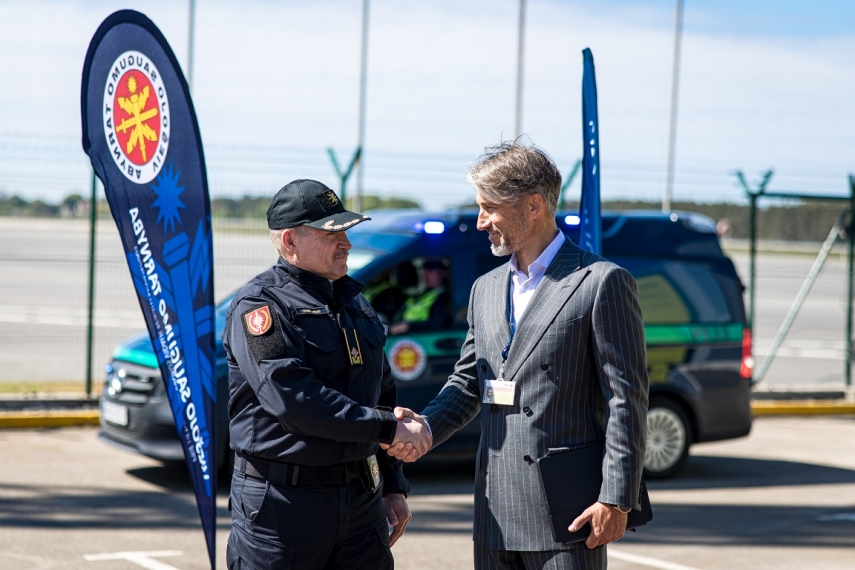
"Drone users still underestimate the risks and legal requirements. Our response is prompt and principled, especially at the approaches to airports and other strategic objects. We remind all that a reckless drone flight can cause serious consequences for air traffic safety," says General Viktoras Grabauskas, Commander of the Public Security Service.
Drone detection system – highly advanced and accurate
The system monitors the airspace with the help of antennas and detects the scattering of radio signals. Within the boundaries of the aerodrome and its protection zones, monitoring is carried out around the clock throughout the year. The technical capabilities of the new system allow to determine the location, direction of movement, altitude, time and other identification parameters of the drone, as well as the geographical location of the drone operator. During the development of the new system, response algorithms have been established in interaction with aviation security partners – the Public Security Service (VST) and local police. In order to ensure airspace safety and flight safety, decisions are made together with the air navigation services provider on the possible suspension of air traffic, and VST forces are sent to detect the violator.
In all cases when an unauthorised drone flight takes place in the prohibited zone, the drone detection system "Drone Radar" notifies the Head of Aviation Security of Palanga Airport, the Head of the Public Security Service Forces protecting this important state object, the Klaipėda County Police watchmen and the Senior Officer of the Joint Operations Centre of the Public Security Service.
Upon receipt of a notification from the system, the crews of the Public Security Service and the police immediately react to the violation of the prohibited zone of Palanga Airport, and the interaction of the response between the forces responding to the violations is ensured and coordinated by the Joint Operations Centre of the Public Security Service.
Significant fines for violators
Administrative proceedings against the detained offender are carried out by the officers of the Public Security Service. Since the activation of the system for piloting drones in the prohibited zone of Palanga Airport without permission, the Public Security Service has already brought 5 persons to administrative responsibility.
It should be noted that piloting drones in prohibited zones without a permit, in accordance with Article 393 (4) of the Code of Administrative Offences of the Republic of Lithuania, incurs a fine from 400 to 800 euros and confiscation of the drone may be imposed. If such a violation is committed repeatedly, a fine from 800 to 1200 euros would be threatened, with mandatory confiscation of the drone.
Safe drone control is everyone's shared responsibility
The Public Security Service and Lithuanian Airports remind that before using an unmanned aircraft (drone), it is mandatory to make sure that the place where it is located does not fall into the prohibited territory and that the prior consent of the legal entity of that territory is required. This can be checked: https://utm.ans.lt/avm/#p=7.59/55.159/23.825
If the drone has a camera, the operator must obtain a certificate from the Transport Competence Agency: https://tka.lt/katalogas/bendra-informacija-2
It should be emphasized that drone manufacturers do not assume responsibility for automatic warnings and unauthorized use and all responsibility with consequences lies with the drone operator.
Liability for violations of the rules of procedure for the use of drones is provided for in Article 393 of the Code of Administrative Offences of the Republic of Lithuania. https://www.infolex.lt/ta/336765:str393
More information about the requirements for the use of drones: https://ltsa.lrv.lt/lt/veiklos-sritys/oro-transportas-1/bepilociai-orlaiviai/
The no-fly zone for drones is informed by the warning signs on the perimeter fence of Palanga Airport. After the implementation of the latest detection system, an information campaign will be carried out for residents and guests of the city in order to educate about emerging threats, the boundaries of the no-fly zone, as well as fines for violators of the rules.
It is reminded that all information for those seeking to legally and safely operate an unmanned aircraft (drone) near Lithuanian airports is provided www.ltou.lt/dronai
In the record year 2025, Palanga Airport served almost 448.4 thousand passengers - 18.7 per cent more than in 2024. Palanga Airport also sets records at the beginning of 2026 - the number of passengers grew in both January and February.

Please enter your username and password.

2026 © The Baltic Times /Cookies Policy Privacy Policy