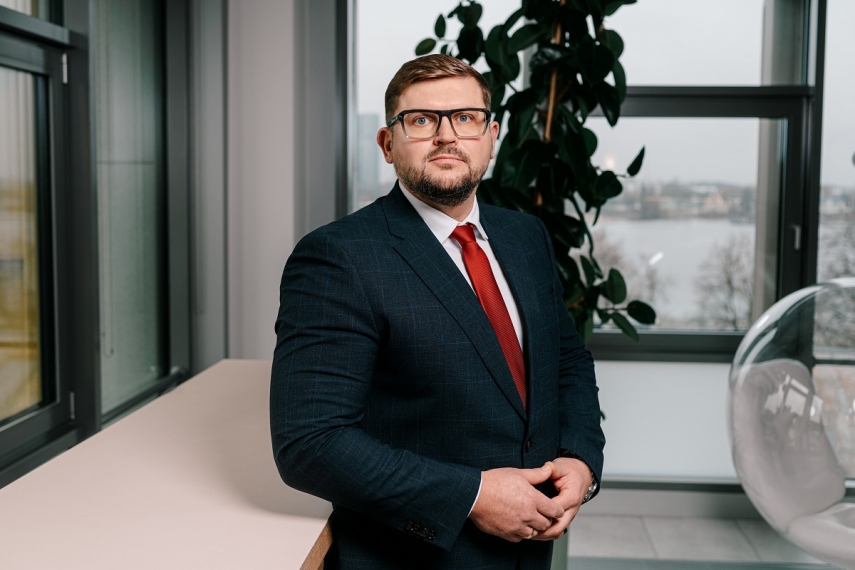

Photo: Toms Jurjevs is the founder and the CEO of Sun Finance
Sun Finance, a Riga-based global fintech company operating in more than 10 countries across four continents and specialising in digital consumer lending, continued to reap new awards in 2025 – the Group was recognised for the fifth consecutive year by The Financial Times among the FT1000 Fastest Growing European Companies, an achievement reached by only 11 companies across Europe. In April, Sun Finance was named Company of the Year at the Baltic Fintech Awards and shortly thereafter surpassed 4 billion euros in total loans issued globally. The Baltic Times Magazine sat down with Toms Jurjevs, the founder and the CEO of the company.
2025 is just another splendid year for you?
The last two years, but especially 2025, have been a period of big growth for us.
Speaking in cowboys’ terms, we were very vigorous and target-driven, while well saddled throughout. However, recently, we decided to adjust the ‘cowboy’ attitude – to be less ‘cowboy’, risk-taking, and more sustainable, putting more checks and balances in the business. Also, expanding the number of licences, obtaining, where possible, those that provide a banking licence, and offering a wider variety of products to benefit customers – such as short-term loans and larger-ticket products.
In the business we are in, it is not just about our own growth but also paying close attention to what is trending and happening in the industry and in the countries in which we operate. The latter is especially important – we need to follow all regulatory changes, to use my previously mentioned term, their own checks and balances. In short, we need to grow along with the industry and the countries to sustain our business. Often, success is also partly about anticipating what is about to come – for example, our products in some countries are growing faster than we predicted.
Speaking of our financial numbers for the first three quarters of 2025, our Group continued its steady upward trend in key financial indicators, recording revenue of 215.4 million euros, an increase of 7.4 percent year-on-year, while EBITDA reached 80.0 million euros, delivering a solid 37.2 percent margin. The net loan portfolio amounted to 191.5 million euros at period end, representing 20.2 percent growth compared to 159.9 million euros in 2024.
When we talked a while ago, you accentuated the key principles – being sustainable, efficient, bureaucracy-free and good-governance-minded – as the cornerstones of your success. Did they change over time? Or perhaps you added new ones in 2025?
The key principles did not change, but we added some others over time. Now, I’d rather speak of an eight-core value system that Sun Finance has worked out and adheres to. As before, we are sticking with the four mentioned, but now we ask and finish each question that arises with a simple “Why?” Why do we need this? Why do we need to enter a new country? Why do we need a new product? In fact, I came up with the question-evaluation “why?” while delivering a speech on stage at a conference in Stockholm.
Our strategy, which has helped us overcome challenges across all four continents where we operate, can be described by the old saying: “Do not put all the eggs in the same basket,” meaning geographical and product diversification.
Besides, I remember another saying of yours that’s etched into my mind: “Treat every euro as if it were your last.”
Indeed, this is one of my favourites, too (smiles), as it goes very well with all the others.
Since 2023, you’ve been operating in Africa. How much of it are you covering? What are your discoveries and disillusionments there?
Currently, we operate only in Kenya and are seeking to secure a banking licence in another country, the name of which I cannot disclose as our application is still pending.
Africa is a very interesting region to work in – very investable, yet not an easy one in which to build a business, especially if you are used to the European way of doing business. When dealing with bureaucracy, the two continents are starkly different. Specifically, in Europe, you apply for a licence and have to wait 12 months for an answer; meanwhile, in Africa, the answer can come anywhere from three days to three years.
To what extent do you employ artificial intelligence?
There is a lot of talk about AI – it seems to me it is blown out of proportion; however, the future is certainly about it. Our engineering, data science, research, and customer care departments use it daily, but decision-making is still done by humans – at Sun Finance, at least.
With so many frauds occurring on the internet, especially in the financial sector, how does Sun Finance address the issue?
Fraud affects not only customers but financial service providers like us as well. There are organised fraud rings that attempt to defraud us – for example, by providing loan applications for non-existent people. To prevent this, we have a separate fraud-prevention team consisting of data and finance specialists who often focus on anticipating what kind of fraud might happen next, where it may occur, and identifying emerging patterns and algorithms. It is a cat-and-mouse game – all the time. We are trying to stay one step ahead.
How will lending look in the future?
(Smiles) I wish I had a crystal ball. To be honest, as someone who has spent years in the industry, I often find myself thinking: “The more I learn and know, the more I understand that I do not know.” The same applies to the future – even the near future – considering all the changes in regulation, competition, and technological advancement. My rough prediction is that banks will see their share shrink, as fintechs like ours increase their foothold in the lending market.
Will it be enough for Sun Finance in 10 years to scan my irises to decide – to approve or reject a loan request?
(Smiles) Technically, we may be ready for that, but the question is whether regulators will allow it.

Please enter your username and password.
2026 © The Baltic Times /Cookies Policy Privacy Policy