Photo: Saeima
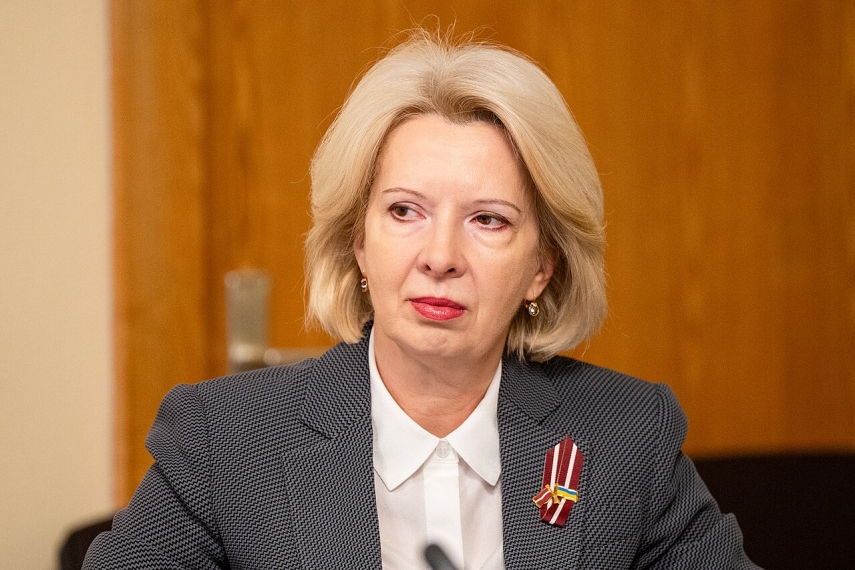
RIGA - Europe must do more, faster, bolder, and more decisively, Inara Murniece (National Alliance), chairperson of the Saeima Foreign Affairs Committee, said during the annual foreign policy debate in parliament Thursday.
The lawmaker noted that the past year brought much turmoil internationally, but Russia's imperialist ambitions to subjugate, destroy, and impose its pseudo-order on the world have not gone away. Russia remains a serious threat not only to the Baltic states and Poland, but to the whole of Europe and NATO, Murniece said.
Quoting NATO Secretary-General Mark Rutte, she said that without US involvement, the European Union (EU) is not yet capable of defending itself against a Russian attack. "Various military experts give different forecasts as to how many years Russia needs to rebuild its military capacity and attack NATO, without excluding scenarios that seem impossible from a rational point of view. That is why the US presence in Europe, and in particular on NATO's Eastern flank, is a decisive deterrent, first and foremost, without which modern European security is unthinkable," Murniece said.
She stressed that Latvia's interests lie in a strong Europe in a strong NATO, with strong transatlantic ties as a long-term security guarantee. "Europe needs to take more responsibility for its own security, but it needs to do so in close cooperation with the US. This means building a good relationship with our strategic partner, the US, in cooperation with the administration of President Donald Trump and the US Congress," the MP explained.
She noted that Latvia highly values the US contribution to Latvia's security, both in terms of military presence, strategic planning, and allied coordination. In particular, Murniece highlighted the role of Canada and Denmark as reliable and consistent allies for the security of Latvia and the entire Baltic region. She said that the Canadian-led NATO Multinational Brigade in Latvia and the practical involvement of Denmark in strengthening defense capabilities showed that solidarity between allies was not declarative. "No, it is real and measurable in concrete actions," Murniece stressed.
The chairperson of the Foreign Affairs Committee noted that Latvia acknowledges European defense as the Europeans' own responsibility and duty. In her view, the US administration's consistent position that NATO members need to invest more in their defense has played a decisive role. "NATO is the winner here, it will be stronger, and Latvia, together with the other Baltic states and Poland, is a model for the whole of Europe in terms of defense spending," Murniece stressed, adding that the defense budget must be spent wisely.
She pointed out that due to high demand, military capabilities cannot be acquired immediately, but everything possible should be done to develop vital capabilities in the region and to manufacture some of the military goods in Latvia. In Murniece's view, the development of the military industry is still not fast enough. According to her, it is essential to adopt good practices from other European countries, such as Denmark, which, in close cooperation with Ukraine, is both developing new production capacities on Ukrainian territory and establishing them in Denmark. "While supporting Ukraine, it would be important to set up joint ventures, so that Latvia could also learn from the Ukrainian experience and obtain war-tested technologies," the MP said.
Murniece agreed with the criticism voiced by Ukrainian President Volodymyr Zelensky at Davos that Europe loves to talk about the future, but avoids acting today. She mentioned that the EU has not yet been able to agree on the full use of Russia's frozen assets for Ukraine, and that ships of the Russian shadow fleet are still operating in the Baltic Sea. "We have been too cautious, too slow, too weak," the MP said.
"Russia respects strength, and its actions and rhetoric change when it gets its teeth kicked in. Europe needs to do more, faster, bolder, more decisively", Murniece said.
She mentioned that as US-led peace talks in Ukraine continue, Russia continues its massive attacks, targeting energy and heating infrastructure and deliberately making civilians' daily lives a struggle for survival. She pointed out that in the 20th century, Ukraine experienced the Holodomor under Joseph Stalin's rule, but today Russia is using genocidal tactics in a different form - to create an energy famine. "But Ukrainians realize that surrender is impossible, because it would mean the victory of the so-called Russian world", the MP said, noting that the Russian world means death, horror, and the end of normality.
Commenting on Foreign Minister Baiba Braze's (New Unity) report to parliament, Murniece thanked the minister and the foreign service for being "more compact" than in previous years. However, Murniece was critical of the performance of the government and the foreign service, pointing out that overall trade volumes with Russia have been increasing. She said that the government coalition had rejected initiatives by the National Alliance, such as the introduction of a war tax or a war levy on goods from Russia and Belarus. "What will you propose instead? There is no such proposal," the MP said.
Murniece was also critical of the government's work on migration policy, noting that Latvia had not obtained an exemption from the EU migration pact and the compulsory solidarity mechanism. In Murniece's view, the Minister of the Interior, Rihards Kozlovskis (New Unity), should have attended today's meeting and explained the situation.
"Latvia's security today depends on the ability of politicians to take timely decisions and assume full political responsibility for them," said Murniece, stressing that there is no room for waiting, self-delusion or empty promises. What is needed now is the ability to negotiate, coordinate, and be at the negotiating table.

Please enter your username and password.

2026 © The Baltic Times /Cookies Policy Privacy Policy